Well here we are in week 12 of the “52 Ancestors in 52 weeks”… and I’m uploading week 3. Procrastination is my middle name. At any rate the prompt for week 3 is Longevity.
For me this immediately conjures up memories of Grandma, my paternal grandmother Ida Emma Fletcher (nee Stace). Grandma may not have reached the magical 100 to get a telegraph from the Queen but she did live a very long life. Much more importantly she had a good quality of life both physically and mentally.
Grandma was born 8th of October 1905 on a cattle station, Tonk’s Camp, outside of Georgetown in Far North Queensland. Tonk’s Camp is a pretty isolated spot geographically even by today’s standards. In the early 20th century it was even more so. It would have been a hard life for her and in many ways I think it influenced her later in life.
Granma married Joseph Fletcher and they eventually settled in Cardwell, a small coastal town in North Queensland. This is where they raised their son, Leslie Fletcher, my father. Les married my mother, Roma, and he adopted my sister and me. At that point Granma and Pop (ie Joseph and Ida Fletcher) became my grandparents. And they were wonderful grandparents. I could not have asked for better.
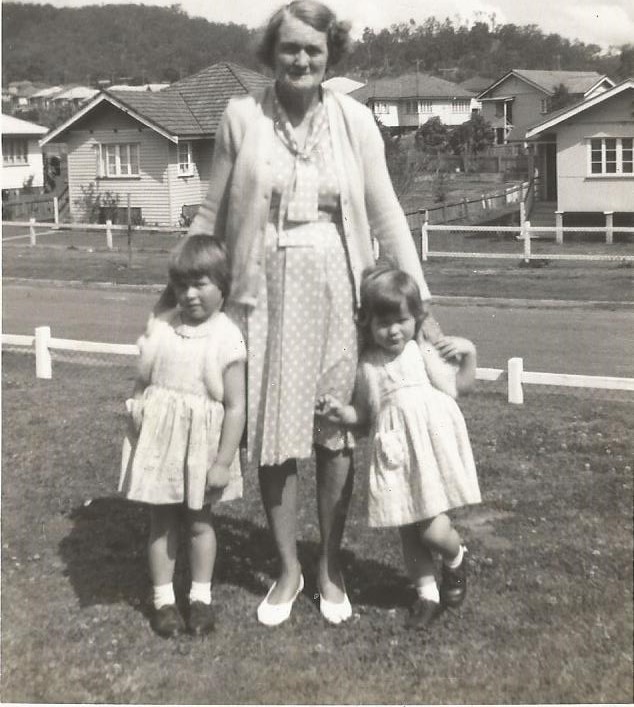
This photo was taken around 1967 during one Granma and Pop’s visits to us in Keperra, Brisbane. Look how identically dressed Rose-Lyn and I are… right down to the shoes and socks. Thanks Mum. Rose is the taller one on the left, and I’m on the right.
Every year as I grew up we would travel to Cardwell for holidays. One thing that really stands out for me is how content Granma was with the simple things in life. She didn’t have a big expensive house or a lot of materials possessions. In fact her house was decorated with cereal box cut-outs. Remember back in those days you’d buy your box of Rice Bubbles or Cornflakes, and on the back of the box there’d be a cardboard cutout that you could cut and fold to make, eg a monkey mask of the CocoaPops monkey. Granma would actually make these things and she’d display them on the walls of the kitchen and the hallway as decorations.
I also remember her cooking. Granma always had either a rice pudding or a spaghetti pudding in the fridge. These were made with left over rice/spaghetti with a baked egg custard and served with tinned peaches or apricots. There was never fresh milk in the house. Granma grew up in the outback without the benefits of refrigeration. She grew up with powered milk – Sunshine milk. This stuck with her for the rest of her life. No fresh milk at Granma’s house.
Then there was the dark side of her cooking – meat, usually fatty lamb chops, was fried in lard – it was heavily salted – after the meat was cooked it was removed from the pan, flour was added, and all that fat was turned into a gravy, just so you don’t miss out on any of the fat…. As you no doubt know, the diet experts tell us to avoid high salt and high fat diets. And we dutifully passed this information on to Granma. We tried to tell her just how unhealthy her high fat, high salt diet was. But, you know what ? When she hit the age of 90 our warnings and protests just looked a little silly.
Other memories I have from those annual childhood visits to Granma and Pop in Cardwell:
The hallway in her house was quite wide and it was jam-packed with photos and memorabilia from times past. You could literally spend hours exploring that room. She had emu eggs that had been blown. Antique toys that my father played with as a child. An old box brownie camera, so old that when she contacted Kodak to see if the camera could be fixed, they asked her if she would donate it to their museum.
The tropical fruit trees in her back yard – custard apples, 5 star fruit, mangoes, coconuts. I spent hours with an axe striping the fibres from coconuts and breaking into the flesh.
Fishing on the jetty, if we caught a fish with eggs – she’d coat the egg sac in flour, salt and pepper and fry it off – big delicacy for her.
Playing cards – Granma always had a deck of cards handy. We’d sit around the kitchen table and play cards for hours. Strip-Jack-naked, Solataire, Euchre, but her favourite was crib. Granma was a mean crib player.She could glance at a crib hand and rattle of the total score in the blink of an eye. Tuesday mornings were spent at the CWA playing cards for prizes such as a tin of beetroot or creamed corn.
The Penetrine – I don’t know what penetrine was – but it features heavily in my memories of Granma. It was green and alcohol based. She always had a bottle of it. And if you cut yourself or grazed yourself out would come the penetrine – it would be liberally poured over the open wound – and it stung likes blazes.
I must confess, when I was young, arrogant and stupid, I’d look at her simple house, I’d look at the cereal cardboard cutouts, and I’d look at her life in general. To my mind, she had no career, she had no achievements, she had no materials possessions of any worth. I used to think – please don’t let me wind up like her. But now I’m older, a little wiser, and a lot humbled by life.
At the end of the day, career, achievements, material possessions mean very little. What is important is the relationships you have with your family, and the impact your have on their lives. Granma was devoted to her family and we all have loving memories of her. That’s her legacy, and its a legacy to be proud of.
 The Restall Gene