I am an Australian; born and bred. That’s my nationality, and it’s certainly my cultural identity, but what about my ethnicity? Like all non-indigenous Australians my ancestors arrived in this country as immigrants, settlers or convicts. You often hear the terms “First Generation Australian” or “Second Generation Australian”, but what do these terms mean?
According to the Australian Bureau of Statistics first generation Australians are people living in Australia who were born overseas. Second generation Australians are Australian-born people living in Australia, with at least one parent who was born overseas. Third-plus generation Australians are Australian-born people living in Australia whose parents were also both born in Australia. They may have one or more grandparent who was born overseas, or several generations of ancestors born in Australia. Data from the 2016 census show that 28% of Australians are first generation, 21% are second generation and 50% are third-plus generation.
I fall into the third generation-plus category. I have one grandparent who was born overseas: Constance Mary Restall is my maternal grandmother who was born in Horsham, Sussex, England. She arrived in Australia on the 15th of September 1913 with her mother and siblings. Her father and elder brother had arrived a little earlier to find work and housing.
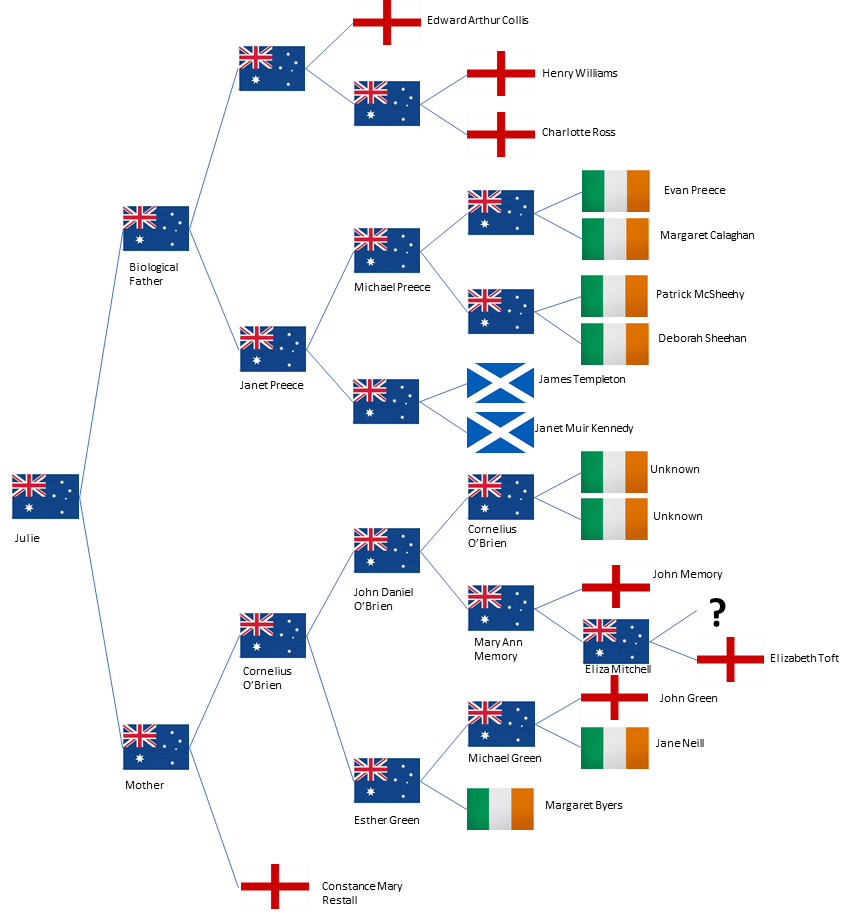
What about the rest of my family? As I began to research it became a bit of a mission to trace each branch back to their arrival in Australia. Who would be the earliest ancestor to arrive in Australia? What were the circumstances behind each arrival? For me, these arrivals would be the foundation of my family history in Australia. To represent this graphically I created a family tree chart using flags.
In this tree each person is represented by the flag of the country they were born in. I am the home person in this tree with an Australian flag. In the next branches you see my mother and biological father, both born in Australia. At the next level are my grandparents; in each case paternal is the upper branch, and maternal is the lower. Each branch is terminated once an ancestor is not born in Australia, and ends with the flag of the country they were born in. So, for example, looking at my grandparents, both paternal grandparents, and my maternal grandfather have Australian flags and all three branches continue. My maternal grandmother has an English flag, and her branch then terminates. The same pattern then continues for my great-grandparents and so on.
Over the last few years, I’ve managed to confidently trace most of my family branches back to the “mother country” – this has always been England, Ireland or Scotland. Most, but not all… I do have two rather annoying brickwalls. Don’t we all?
The first one is identifying the parents of Cornelius O’Brien, the paternal grandfather of my paternal grandfather. Cornelius was born in Australia, probably near Windsor, around 1830. While I cannot yet name either of his parents, I am reasonably confident that they were Irish. So in my “flag” tree I’ve put his parents as unknown, but with an Irish flag.
The second brickwall is the father of Eliza Mitchell, my 3rd great grandmother. Eliza was the illegitimate daughter of Elizabeth Toft and was born between 1815 and 1816. Figuring out who her father was is a work in progress. In the flag tree her father is a question mark.
Overall, discarding for now Eliza’s father, according to my family tree I am 56% English, 32% Irish and 12% Scottish. How does that stack up against DNA tests? First up we need to recognize that while DNA matching to other test takers is extremely accurate, ethnicity results are more a “work in progress”. Also, ethnicity based on family trees goes back over the last few hundred years and is highly dependent on genealogical records. Genetic ethnicity is looking at a time scale of thousands of years. That said my ethnicity results from Ancestry aren’t too far off; 37% English, 32% Irish, 26% Scottish and 5% Scandinavian.
 The Restall Gene